Animal Group Name(COPY FROM ABYSSAL)
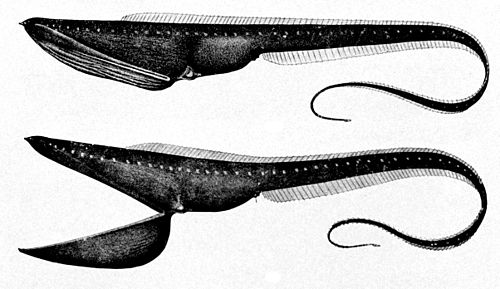
Pelican Eel, Eurypharynx pelecanoides
The morphology of pelican eel specimens is difficult to describe because they are so fragile that they become damaged when they are recovered from the deep sea's immense pressure. However, certain observations about the physical characteristics have been noted from studied specimen. The pelican eel's most notable feature is its large mouth, which is much larger than its body. The mouth is loosely hinged, and can be opened wide enough to swallow a fish much larger than the eel itself. The lower jaw is hinged at the base of the head, with no body mass behind it, making the head look disproportionately large. Its jaw is so large that it is estimated to be about a quarter of the total length of the eel itself.
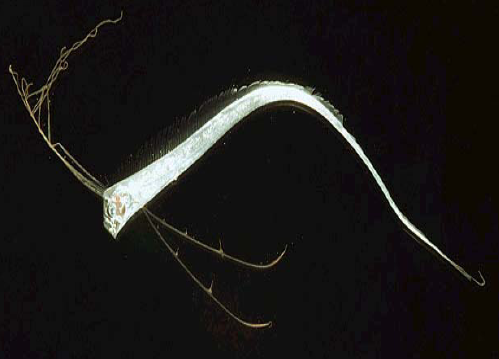
Oarfish, Regalecus glesne
The oarfish is a large and extremely long pelagic lampriform fish belonging to the small family Regalecidae.Found in areas spanning from temperate ocean zones to tropical ones, yet rarely seen by humans, the oarfish family contains three species in two genera.One of these, the giant oarfish (Regalecus glesne), is the longest bony fish alive, growing up to about 8 m (26 ft) in length. The common name oarfish is thought to allude either to their highly compressed and elongated bodies or to the now discredited belief that the fish "row" themselves through the water with their pelvic fins. The family name Regalecidae is derived from the Latin regalis, meaning "royal". Although the larger species are considered game fish and are fished commercially on a small scale, oarfish are rarely caught alive; their flesh is not well regarded for eating due to its gelatinous consistency.
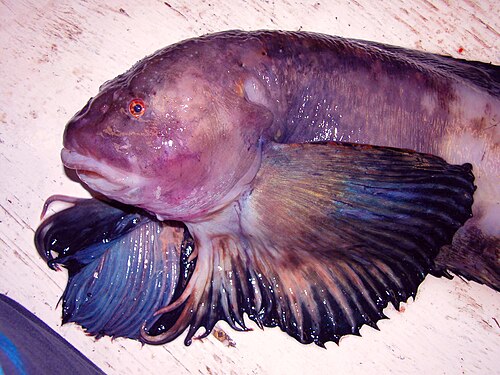
Snailfish, Liparis catharus
Species of deep-sea snailfish have been studied and compared to other ray-finned fishes (also known as teleosts) to analyze their adaptions to deep-sea conditions. The genomes of both the Yap hadal snailfish and Mariana hadal snailfish have been found to contain an abundance of the fmo3 gene, which produces the trimethylamine N-oxide (TMAO) protein stabilizer. Analysis of Yap hadal snailfish reveals a loss of olfactory receptors and gain of taste receptors, possibly due to the fairly restricted availability of food in the deep-sea. Additionally, perhaps due to lack of light in the deep sea, the Yap genome includes fewer copies of crystallin genes, which encode proteins that sense light and assist in focused vision, in comparison to other teleosts.