Animal Group Name (COPY FROM ABYSSAL)
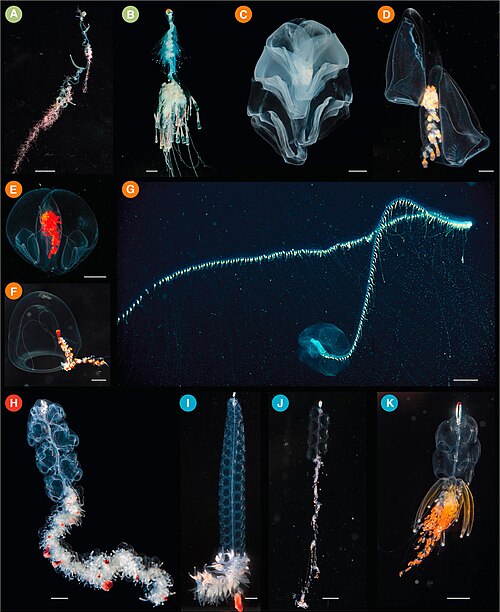
Siphonophore, Rhizophysa eysenhardtii
A siphonophore (from Ancient Greek σίφων (siphōn), meaning "tube" and -φόρος (-phóros), meaning "bearing") is a member of the order Siphonophorae. According to the World Register of Marine Species, the order contains 175 species described thus far. Siphonophores are highly polymorphic and complex organisms. Although they may appear to be individual organisms, each specimen is in fact a colonial organism composed of medusoid and polypoid zooids that are morphologically and functionally specialized. Zooids are multicellular units that develop from a single fertilized egg and combine to create functional colonies able to reproduce, digest, float, maintain body positioning, and use jet propulsion to move. Most colonies are long, thin, transparent floaters living in the pelagic zone.
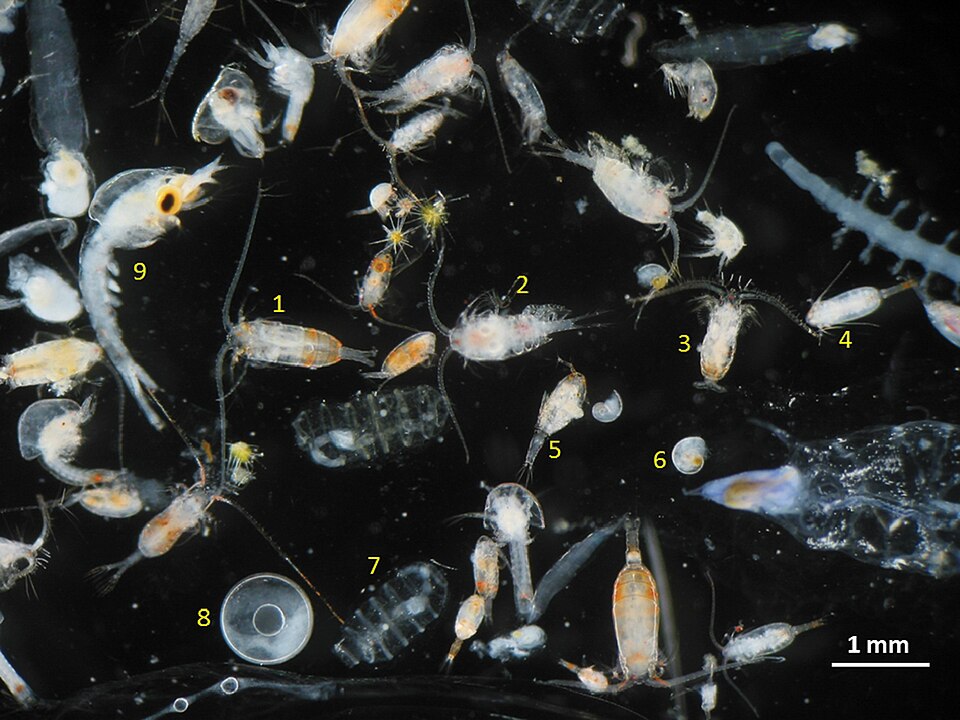
Zooplankton,
Zooplankton are the heterotrophic component of the planktonic community, having to consume other organisms to thrive. The name comes from Ancient Greek ζῷον (zōîon), meaning "animal", and πλαγκτός (planktós), meaning "drifter, wanderer, roamer", and thus, "animal drifter". Plankton are aquatic organisms that are unable to swim effectively against currents. Consequently, they drift or are carried along by currents in the ocean, or by currents in seas, lakes or rivers.
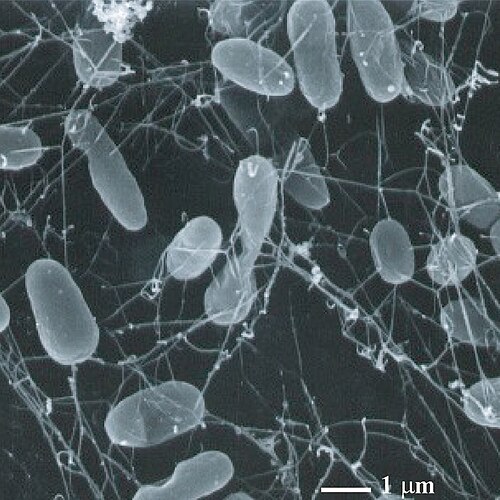
Pyrolobus fumarii
Pyrolobus fumarii (Latin for "fire lobe of the chimney") is a species of archaea known for living and reproducing at extremely high temperatures that kill most organisms. P. fumarii is known as a hyperthermophile obligately chemolithoautotroph (it cannot use carbon from organic sources). In the simplest terms, this archaea grows best in warm temperatures ranging from 80–115 °C (176–239 °F). It also uses preformed molecules as its energy source rather than light, inorganic as an electron donor, and CO2 is used as a carbon source. It was first discovered in a black smoker hydrothermal vent at the Mid-Atlantic Ridge and described in 1996, setting the upper-temperature threshold for known life to exist at 113 °C (235 °F) with an optimal temperature of 106 °C (223 °F), and can survive even higher temperatures (one hour in an autoclave at 121 °C (250 °F)). This species "freezes" or solidifies and ceases growth at temperatures of 90 °C (194 °F) and below.